Thursday, September 30, 2010


Friday, April 30, 2010
Tuesday, February 16, 2010
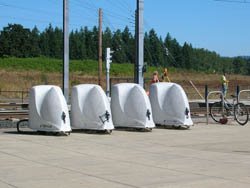
BikeLid at Austin Park and Ride
PUT A LID ON IT!
Austin's Capital Metro is offering commuters at their Pavilion Park & Ride a new, safe and eco-friendly bicycle parking product known as the BikeLid. The BikeLid is an innovative form of bicycle parking that provides protection from vandalism, theft and weather elements. The "lids" are a no-cost-to-the-bikers installation, coordinated through the City of Austin's Bicycle and Pedestrian Program and BikeLid Systems, LLC, as a test market. If customer feedback is positive, Capital Metro may decide to install more BikeLids at passenger facilities throughout city. The lids are a green product, made from industrial plastic waste materials and recycled steel, and is 100% recyclable. – Texas Transit Association
Monday, December 21, 2009
Thursday, October 29, 2009
RCTC Report on BikeLid

Excerpt from the Riverside Transportation Commission Commuter Rail Update Report (May 2008) :
Bicycle Facility Upgrade at Riverside Downtown and North Main Corona Stations
In order to accommodate and promote bicycle ridership, the Commission has invested in both bicycle lockers and racks at its West Corona, La Sierra and Pedley stations. Until recently, the Commission lacked secure and covered bicycle facilities at its two most utilized stations, Riverside Downtown and North Main Corona.
In addition to bicycle racks, lockers provide an added level of security against possible theft and vandalism. However, conventional lockers require continuous maintenance and management. Lock mechanisms break; keys have to be distributed, tracked and hopefully returned; key deposits and refunds have to be tracked and accounted for; the potential for misuse, non-use and under use is significant as conventional lockers are assigned. All this adds complexity and cost to a conventional bike locker program, diminishing the benefit to the Commission as well as the overall passenger experience.
To address such complexity and costs, alternatives to conventional bike lockers were explored. The primary factor contributing to the complexity and cost of conventional lockers is the design. Essentially metal boxes, conventional lockers pose particular challenges to ensure proper and efficient use. In the past, lockers have been used for storage, remained assigned but unused, are an ideal habitat for any number of pests and pose a potential safety threat concealing devices intended to inflict public harm.
Demonstration of the BikeLid’s clamshell design.
In consideration of these concerns, the Commission has purchased and installed six BikeLids at both the Riverside Downtown and North Main Corona stations. The BikeLid is a competitively priced alternative product that significantly alleviates both the complexity and cost of a traditional bike locker. The design is essentially hybrid, integrating the simplicity of a bike rack with a clamshell hinged lockable cover. BikeLids allow first come/first served single use while patrons utilize their own standard bicycle lock. This eliminates the need of a separate key and lock mechanism while still providing the security of covered storage, discouraging misuse and optimizing proper use. Furthermore, the unique design has been demonstrated to increase awareness and consideration of bicycle use. The BikeLid product is utilized at the Oceanside transit center. The units are durable, simple and attractive. BikeLid provides a 10-year warranty on material and workmanship.
http://www.rctc.org/
Tuesday, September 22, 2009
Thursday, August 27, 2009
On a Sustainable Journey, Travel by Bike
Traveling by bicycle is a sustainable scenario for the human environment. Whether for business, leisure, or simply running errands, riding a bike is by its very nature one of the most sustainable forms of transportation, used by millions worldwide on a daily basis.
As the only truly human powered vehicle. Riding a bicycle requires no fossil fuel. According to the US EPA, American car owners drive an average of 40 miles per day. If they rode a bicycle instead, they would save on average 14 gallons of gas (and over $45) each week. Many petroleum sources are located in environmentally sensitive of politically unstable areas, and the more we can do as a culture to reduce our dependence, the more sustainable we become.
Bicycle riding also burns around 500 calories per hour, keeps tons of greenhouse gas emissions from escaping into the environment, and bicyclists experience the world at a pace that's more resonant with nature. Communities that encourage non-motorized transportation enjoy more human interaction, less pollution and overall healthier lifestyles. This in turn makes the communities desirable and they get to enjoy the economic benefits that come from that desirability.
People who bike ride sustain the environment and they sustain; both physically and mentally. The way forward for not only our country but the world is through more responsible, sustained use of limited capital and resources. Bicycling is a great way to travel on that sustainable journey.
www.bikelid.com
As the only truly human powered vehicle. Riding a bicycle requires no fossil fuel. According to the US EPA, American car owners drive an average of 40 miles per day. If they rode a bicycle instead, they would save on average 14 gallons of gas (and over $45) each week. Many petroleum sources are located in environmentally sensitive of politically unstable areas, and the more we can do as a culture to reduce our dependence, the more sustainable we become.
Bicycle riding also burns around 500 calories per hour, keeps tons of greenhouse gas emissions from escaping into the environment, and bicyclists experience the world at a pace that's more resonant with nature. Communities that encourage non-motorized transportation enjoy more human interaction, less pollution and overall healthier lifestyles. This in turn makes the communities desirable and they get to enjoy the economic benefits that come from that desirability.
People who bike ride sustain the environment and they sustain; both physically and mentally. The way forward for not only our country but the world is through more responsible, sustained use of limited capital and resources. Bicycling is a great way to travel on that sustainable journey.
www.bikelid.com
Friday, June 26, 2009
BikeLid Seen in US Infrastructure Magazine
Check out the editorial on bicycle parking at this link:
http://www.americainfra.com/article/Issue-1/Transportation/Secure-Bicycle-Parking-is-Key/
http://www.americainfra.com/article/Issue-1/Transportation/Secure-Bicycle-Parking-is-Key/
Wednesday, May 20, 2009
From Clean Air NY - Urgent Air Quality Action Day
An Air Quality Action Day is forecast in our region for tomorrow (Thursday, May 21, 2009).
URGENT!
The New York State Department of Transportation has declared that tomorrow (Thursday, May 21, 2009) will be an Air Quality Action Day in the downstate metro area due to forecasted high levels of ground-level ozone pollution. While tomorrow will still be a day when people can go about most of their normal activities, such as going to work, driving may be one of the most polluting activities that people do tomorrow, and we encourage everyone to leave their cars at home if possible.
Ground-level ozone is a respiratory irritant that can trigger asthma attacks and aggravate emphysema, bronchitis and other respiratory ailments. Children, people with pre-existing respiratory or heart conditions, people doing strenuous outdoor work or exercise and the elderly are particularly vulnerable to the effects of ozone.
As an employer, there are several steps you can take to help your employees reduce the formation of pollution and ensure their health and productivity:
The most important step is to let your employees know about the Air Quality Action Day by forwarding this e-mail to them.
Encourage employees to take the following actions on Air Quality Action Days:
Combine errands into a single trip, rather than separate trips. This can help save time and reduce pollution.
Postpone unnecessary trips. Avoiding motor vehicle trips on Air Quality Action Days will prevent the formation of air pollution.
Take the subway, bus or train when possible.
Refuel your vehicle in the evening when it is cooler outside.
Avoid letting your vehicle idle, such as at the fast food or bank teller drive-thru.
Postpone using gas-powered gardening equipment such as lawn mowers on Air Quality Action Days. Wait for a day when air quality is better.
Develop a commuter benefits program and/or telecommute policy for your organization. It’s good for your employees and makes business sense.
Refuel fleet vehicles in the evening when it is cooler outside on Air Quality Action Days.
Avoid fleet vehicle idling every day and especially on Air Quality Action Days.
Take our message home with you. Tell your friends and family about the upcoming Air Quality Action Day.
To learn more about improving air quality or developing a commuter benefits program, visit CleanAirNY.org or call 1-877-ILUVAIR (1-877-458-8247).
Clean Air NY is sponsored by the New York State Department of Transportation in support of regionwide air-quality efforts.
To ensure the delivery of these updates, please be sure to add info@CleanAirNY.org to your e-mail address book or safe list.
CleanAirNY.org
1-877-ILUVAIR (1-877-458-8247)
342 Broadway
Suite 404
New York, NY 10013
info@CleanAirNY.org
Update Profile / Unsubscribe
URGENT!
The New York State Department of Transportation has declared that tomorrow (Thursday, May 21, 2009) will be an Air Quality Action Day in the downstate metro area due to forecasted high levels of ground-level ozone pollution. While tomorrow will still be a day when people can go about most of their normal activities, such as going to work, driving may be one of the most polluting activities that people do tomorrow, and we encourage everyone to leave their cars at home if possible.
Ground-level ozone is a respiratory irritant that can trigger asthma attacks and aggravate emphysema, bronchitis and other respiratory ailments. Children, people with pre-existing respiratory or heart conditions, people doing strenuous outdoor work or exercise and the elderly are particularly vulnerable to the effects of ozone.
As an employer, there are several steps you can take to help your employees reduce the formation of pollution and ensure their health and productivity:
The most important step is to let your employees know about the Air Quality Action Day by forwarding this e-mail to them.
Encourage employees to take the following actions on Air Quality Action Days:
Combine errands into a single trip, rather than separate trips. This can help save time and reduce pollution.
Postpone unnecessary trips. Avoiding motor vehicle trips on Air Quality Action Days will prevent the formation of air pollution.
Take the subway, bus or train when possible.
Refuel your vehicle in the evening when it is cooler outside.
Avoid letting your vehicle idle, such as at the fast food or bank teller drive-thru.
Postpone using gas-powered gardening equipment such as lawn mowers on Air Quality Action Days. Wait for a day when air quality is better.
Develop a commuter benefits program and/or telecommute policy for your organization. It’s good for your employees and makes business sense.
Refuel fleet vehicles in the evening when it is cooler outside on Air Quality Action Days.
Avoid fleet vehicle idling every day and especially on Air Quality Action Days.
Take our message home with you. Tell your friends and family about the upcoming Air Quality Action Day.
To learn more about improving air quality or developing a commuter benefits program, visit CleanAirNY.org or call 1-877-ILUVAIR (1-877-458-8247).
Clean Air NY is sponsored by the New York State Department of Transportation in support of regionwide air-quality efforts.
To ensure the delivery of these updates, please be sure to add info@CleanAirNY.org to your e-mail address book or safe list.
CleanAirNY.org
1-877-ILUVAIR (1-877-458-8247)
342 Broadway
Suite 404
New York, NY 10013
info@CleanAirNY.org
Update Profile / Unsubscribe
Thursday, April 30, 2009
BikeLids at West Baltimore MARC


There are two BikeLids now located at the West Baltimore MARC park and ride lot.
Wednesday, April 15, 2009
Austin tests BikeLid
Check out this story from Austin. They have a high rate of bicycle theft and are looking to the BikeLid to help solve the problem.
http://www.kvue.com/news/local/stories/041309kvue-Bike-Theft-Prevention-WH.d1633ddb.html
http://www.kvue.com/news/local/stories/041309kvue-Bike-Theft-Prevention-WH.d1633ddb.html
Tuesday, March 3, 2009
2008 Vehicle Miles of Travel Decreases
December 2008 Traffic Volume Trends
Travel on all roads and streets changed by -1.6% (-3.8 billion vehicle miles)for December 2008 as compared with December 2007.
Travel for the month is estimated to be 237.2 billion vehicle miles.
Cumulative Travel for 2008 changed by -3.6% (-107.9 billion vehicle miles).
Cumulative estimate for the year is 2,921.9 billion vehicle miles of travel.
(FHWA, 2009)
Travel on all roads and streets changed by -1.6% (-3.8 billion vehicle miles)for December 2008 as compared with December 2007.
Travel for the month is estimated to be 237.2 billion vehicle miles.
Cumulative Travel for 2008 changed by -3.6% (-107.9 billion vehicle miles).
Cumulative estimate for the year is 2,921.9 billion vehicle miles of travel.
(FHWA, 2009)
Thursday, February 26, 2009
New Health Study promotes building bicycle lanes
A joint American/British study out today states that 1 out of 3 cancer cases can be prevented by a healthy lifestyle. This is just common sense. Americans can't continue to eat fast food and not exercise. Then they wonder why they are sick and unhealthy. I can't even tolerate the smell of a fast food restaurant let alone put that stuff in my body.
Here are some of the recommendations, taken directly from the news release:
Governments should build walking and cycling routes.
The food and drinks industry should make public health an "explicit priority."
Schools should encourage exercise and provide healthy food.
Schools, workplaces and institutions should remove junk food from vending machines.
Health professionals should provide more information about healthy living and cancer prevention.
People should use nutrition guides and food labels to buy healthier food for their families.
Here are some of the recommendations, taken directly from the news release:
Governments should build walking and cycling routes.
The food and drinks industry should make public health an "explicit priority."
Schools should encourage exercise and provide healthy food.
Schools, workplaces and institutions should remove junk food from vending machines.
Health professionals should provide more information about healthy living and cancer prevention.
People should use nutrition guides and food labels to buy healthier food for their families.
Tuesday, February 10, 2009
Good information source for bicycling advocacy
http://www.bikeleague.org/programs/bikeadvocacy/
The League of American Bicyclists has a great website. Check it out, and get updates on current events and issues affecting bicycling.
The League of American Bicyclists has a great website. Check it out, and get updates on current events and issues affecting bicycling.
Monday, February 2, 2009

Friday, January 30, 2009
BikeLids get Wrapped! Incredible Options for Secure Covered Bicycle Parking
A new innovation at BikeLid is our new wrap. The lid can be wrapped in art, nature or commerce. Revenue can be generated with this concept bringing much needed covered and secure parking to your area. Check out some of our mock designs. The ideas are endless. Call me for more samples!


Bicycle Access in Buildings, New York City
New York City is pushing for a local law to amend the administrative code of the city of New Yori, in relation to bicycle access and storage in buildings. If you are interested in reading ARTICLE 504. BICYCLE ACCESS IN BUILDINGS
follow this link-
http://webdocs.nyccouncil.info/attachments/86194.htm?CFID=2732476&CFTOKEN=17773251
follow this link-
http://webdocs.nyccouncil.info/attachments/86194.htm?CFID=2732476&CFTOKEN=17773251
Bike Parking funds May Increase with Stimulus Package
According to the Washington Post in yesterdays story "New Cash, Not New Projects in Stimulus," there will be a focus on the funding of bus, bicycle and pedestrian projects. This could be good news for increasing bicycle parking.
Subscribe to:
Posts (Atom)