Tuesday, September 22, 2009


Thursday, August 27, 2009
On a Sustainable Journey, Travel by Bike
Traveling by bicycle is a sustainable scenario for the human environment. Whether for business, leisure, or simply running errands, riding a bike is by its very nature one of the most sustainable forms of transportation, used by millions worldwide on a daily basis.
As the only truly human powered vehicle. Riding a bicycle requires no fossil fuel. According to the US EPA, American car owners drive an average of 40 miles per day. If they rode a bicycle instead, they would save on average 14 gallons of gas (and over $45) each week. Many petroleum sources are located in environmentally sensitive of politically unstable areas, and the more we can do as a culture to reduce our dependence, the more sustainable we become.
Bicycle riding also burns around 500 calories per hour, keeps tons of greenhouse gas emissions from escaping into the environment, and bicyclists experience the world at a pace that's more resonant with nature. Communities that encourage non-motorized transportation enjoy more human interaction, less pollution and overall healthier lifestyles. This in turn makes the communities desirable and they get to enjoy the economic benefits that come from that desirability.
People who bike ride sustain the environment and they sustain; both physically and mentally. The way forward for not only our country but the world is through more responsible, sustained use of limited capital and resources. Bicycling is a great way to travel on that sustainable journey.
www.bikelid.com
As the only truly human powered vehicle. Riding a bicycle requires no fossil fuel. According to the US EPA, American car owners drive an average of 40 miles per day. If they rode a bicycle instead, they would save on average 14 gallons of gas (and over $45) each week. Many petroleum sources are located in environmentally sensitive of politically unstable areas, and the more we can do as a culture to reduce our dependence, the more sustainable we become.
Bicycle riding also burns around 500 calories per hour, keeps tons of greenhouse gas emissions from escaping into the environment, and bicyclists experience the world at a pace that's more resonant with nature. Communities that encourage non-motorized transportation enjoy more human interaction, less pollution and overall healthier lifestyles. This in turn makes the communities desirable and they get to enjoy the economic benefits that come from that desirability.
People who bike ride sustain the environment and they sustain; both physically and mentally. The way forward for not only our country but the world is through more responsible, sustained use of limited capital and resources. Bicycling is a great way to travel on that sustainable journey.
www.bikelid.com
Friday, June 26, 2009
BikeLid Seen in US Infrastructure Magazine
Check out the editorial on bicycle parking at this link:
http://www.americainfra.com/article/Issue-1/Transportation/Secure-Bicycle-Parking-is-Key/
http://www.americainfra.com/article/Issue-1/Transportation/Secure-Bicycle-Parking-is-Key/
Wednesday, May 20, 2009
From Clean Air NY - Urgent Air Quality Action Day
An Air Quality Action Day is forecast in our region for tomorrow (Thursday, May 21, 2009).
URGENT!
The New York State Department of Transportation has declared that tomorrow (Thursday, May 21, 2009) will be an Air Quality Action Day in the downstate metro area due to forecasted high levels of ground-level ozone pollution. While tomorrow will still be a day when people can go about most of their normal activities, such as going to work, driving may be one of the most polluting activities that people do tomorrow, and we encourage everyone to leave their cars at home if possible.
Ground-level ozone is a respiratory irritant that can trigger asthma attacks and aggravate emphysema, bronchitis and other respiratory ailments. Children, people with pre-existing respiratory or heart conditions, people doing strenuous outdoor work or exercise and the elderly are particularly vulnerable to the effects of ozone.
As an employer, there are several steps you can take to help your employees reduce the formation of pollution and ensure their health and productivity:
The most important step is to let your employees know about the Air Quality Action Day by forwarding this e-mail to them.
Encourage employees to take the following actions on Air Quality Action Days:
Combine errands into a single trip, rather than separate trips. This can help save time and reduce pollution.
Postpone unnecessary trips. Avoiding motor vehicle trips on Air Quality Action Days will prevent the formation of air pollution.
Take the subway, bus or train when possible.
Refuel your vehicle in the evening when it is cooler outside.
Avoid letting your vehicle idle, such as at the fast food or bank teller drive-thru.
Postpone using gas-powered gardening equipment such as lawn mowers on Air Quality Action Days. Wait for a day when air quality is better.
Develop a commuter benefits program and/or telecommute policy for your organization. It’s good for your employees and makes business sense.
Refuel fleet vehicles in the evening when it is cooler outside on Air Quality Action Days.
Avoid fleet vehicle idling every day and especially on Air Quality Action Days.
Take our message home with you. Tell your friends and family about the upcoming Air Quality Action Day.
To learn more about improving air quality or developing a commuter benefits program, visit CleanAirNY.org or call 1-877-ILUVAIR (1-877-458-8247).
Clean Air NY is sponsored by the New York State Department of Transportation in support of regionwide air-quality efforts.
To ensure the delivery of these updates, please be sure to add info@CleanAirNY.org to your e-mail address book or safe list.
CleanAirNY.org
1-877-ILUVAIR (1-877-458-8247)
342 Broadway
Suite 404
New York, NY 10013
info@CleanAirNY.org
Update Profile / Unsubscribe
URGENT!
The New York State Department of Transportation has declared that tomorrow (Thursday, May 21, 2009) will be an Air Quality Action Day in the downstate metro area due to forecasted high levels of ground-level ozone pollution. While tomorrow will still be a day when people can go about most of their normal activities, such as going to work, driving may be one of the most polluting activities that people do tomorrow, and we encourage everyone to leave their cars at home if possible.
Ground-level ozone is a respiratory irritant that can trigger asthma attacks and aggravate emphysema, bronchitis and other respiratory ailments. Children, people with pre-existing respiratory or heart conditions, people doing strenuous outdoor work or exercise and the elderly are particularly vulnerable to the effects of ozone.
As an employer, there are several steps you can take to help your employees reduce the formation of pollution and ensure their health and productivity:
The most important step is to let your employees know about the Air Quality Action Day by forwarding this e-mail to them.
Encourage employees to take the following actions on Air Quality Action Days:
Combine errands into a single trip, rather than separate trips. This can help save time and reduce pollution.
Postpone unnecessary trips. Avoiding motor vehicle trips on Air Quality Action Days will prevent the formation of air pollution.
Take the subway, bus or train when possible.
Refuel your vehicle in the evening when it is cooler outside.
Avoid letting your vehicle idle, such as at the fast food or bank teller drive-thru.
Postpone using gas-powered gardening equipment such as lawn mowers on Air Quality Action Days. Wait for a day when air quality is better.
Develop a commuter benefits program and/or telecommute policy for your organization. It’s good for your employees and makes business sense.
Refuel fleet vehicles in the evening when it is cooler outside on Air Quality Action Days.
Avoid fleet vehicle idling every day and especially on Air Quality Action Days.
Take our message home with you. Tell your friends and family about the upcoming Air Quality Action Day.
To learn more about improving air quality or developing a commuter benefits program, visit CleanAirNY.org or call 1-877-ILUVAIR (1-877-458-8247).
Clean Air NY is sponsored by the New York State Department of Transportation in support of regionwide air-quality efforts.
To ensure the delivery of these updates, please be sure to add info@CleanAirNY.org to your e-mail address book or safe list.
CleanAirNY.org
1-877-ILUVAIR (1-877-458-8247)
342 Broadway
Suite 404
New York, NY 10013
info@CleanAirNY.org
Update Profile / Unsubscribe
Thursday, April 30, 2009
BikeLids at West Baltimore MARC


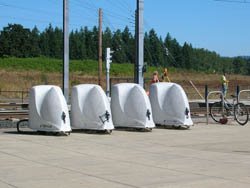
There are two BikeLids now located at the West Baltimore MARC park and ride lot.
Wednesday, April 15, 2009
Austin tests BikeLid
Check out this story from Austin. They have a high rate of bicycle theft and are looking to the BikeLid to help solve the problem.
http://www.kvue.com/news/local/stories/041309kvue-Bike-Theft-Prevention-WH.d1633ddb.html
http://www.kvue.com/news/local/stories/041309kvue-Bike-Theft-Prevention-WH.d1633ddb.html
Tuesday, March 3, 2009
2008 Vehicle Miles of Travel Decreases
December 2008 Traffic Volume Trends
Travel on all roads and streets changed by -1.6% (-3.8 billion vehicle miles)for December 2008 as compared with December 2007.
Travel for the month is estimated to be 237.2 billion vehicle miles.
Cumulative Travel for 2008 changed by -3.6% (-107.9 billion vehicle miles).
Cumulative estimate for the year is 2,921.9 billion vehicle miles of travel.
(FHWA, 2009)
Travel on all roads and streets changed by -1.6% (-3.8 billion vehicle miles)for December 2008 as compared with December 2007.
Travel for the month is estimated to be 237.2 billion vehicle miles.
Cumulative Travel for 2008 changed by -3.6% (-107.9 billion vehicle miles).
Cumulative estimate for the year is 2,921.9 billion vehicle miles of travel.
(FHWA, 2009)
Subscribe to:
Posts (Atom)